It is well known that stress, diet, hormones and medications can cause hair loss. Of course there is genetic hair loss and hair loss caused by certain conditions like Alopecia or illnesses like Lupus. But, do the young people today know about the fact that their hairstyles can also cause thinning, shedding and hair loss as well? We are talking about long term damage.
No matter what race or gender, certain hairstyles are popular in today’s culture and they can cause severe damage to the hair. Below are a few of the current styles that can damage hair.

- Dreadlocks
- Cornrows
- Weaves
- Improperly Applied Extensions
- Hair Straightening
All of the above can and do damage to the scalp and hair follicles. Some solutions have been suggested by hair restoration specialists and they include using hair thickening shampoos and conditioners that DO NOT contain Sulfates, Parabens, Mineral Oil, Ethylene Oxide and Phosphates. Scalp treatments are also recommended no matter what your age race or gender.
Pulling the hair tightly in order to keep up with the current cultural trends without the proper hair care can be a life-long problem that will stay with young people as they age. This is called traction alopecia.
It is wise to talk to a hair restoration professional about the downsides to wearing the hairstyles that are current and trendy and to ask them about products and treatments that can protect from future damage.
If you are wearing one of the above hairstyles and noticing that your hair is thinning out, shedding more than usual or breaking off you contract us today so that we can evaluate you and get you and your hair back on track. It would be wise to be safe rather than sorry. A few years down the road when these styles no longer appeal to you the damage may already be done.

It wasn’t really something that I noticed over-night….it was gradual. I suppose that I avoided the truth for as long as I could because of vanity or fear or denial. Nevertheless, I had to face the fact that I could no longer wear my hair the way I was used too. The crazy thing is that my hair was thin on only one side and the rest seemed normal.
I looked up the different causes for hair loss and was overwhelmed by what I discovered….did I have Alopecia Areata or was it the medication I take for Diabetes? Is my diet messed up or is it because I am getting older? So many causes and, to my dismay, so many solutions. Which one defined my particular problem and how was I going to about finding a remedy?
I was pretty sure that I wouldn’t need Laser therapy or a hair transplant. I had tried some over-the-counter products but they only seemed to make things worse. So what next? Scalp treatments, maybe. I pondered this for weeks and as I pondered (and avoided), more hair got thinner and I began to feel embarrassed about the ridiculous way that I looked and felt.
Finally, I called a local salon and explained my problem. They said that they only dealt with the usual menu of hair styling options…colouring, cutting, perming, blow drying. Some of those options actually sounded as if they would do more harm to my hair. Perming, colouring? Not the best way to maintain a healthy head of hair, in my opinion. I had done those things many times over the years and I suspected that I was now living with the consequences of constantly messing with what was once really thick and healthy hair.
So, I took to the internet and much to my surprise found several places that specialized in hair restoration. Hair restoration….just the words scared me. Was I going to be bald and wind up with no hair at all? I am female and the thought of that was too much to handle.
The first place that I called was sort of cold; by cold, I mean disinterested. The person on the phone was vague and causally threw out several different types of treatments that I was confused about. How could she know what I needed without ever seeing me or my particular hair situation? Shouldn’t this be up close and personal before making a judgment as to what treatment I might need?
The second place I called was worse…they scared me to death with the possibilities that I might be facing and still, they had never seen me in person. I began to think that maybe this was how the hair restoration (there are those words again..) industry functioned.
By the third call, to Continental Hair, I had all but given up when a lovely woman on the other end of the phone suggest that I come in for a free evaluation. Now that sounded more like it. At least she would be actually looking at my hair.
To make a very long story short, I went to that particular salon and wound up getting my free evaluation and some really good advice. I ended up buying a treatment program for regular weekly scalp treatments along with some products that would aid the restoring of the hair that I had and the hair that I had lost. Whats more, they are there for me in the event that my hair does, (god forbid) fall out.
It took a month or so but I began to see a difference. I am not going to tell you that I have all of my once thick hair back or that I turned into an old-school Farah Fawcett. But, what I did see was more hair where there had been a lot less. I can now style my hair in several different ways just like I used too and I am no longer embarrassed to go out in public.
There are different solutions for different people and different conditions but no matter what your particular situation is. I suggest that you find a qualified hair technician who knows what they are talking about and can properly evaluate your situation. Find a place that will work with you and offer several varieties of treatment and financial arrangements to suit your needs and your budget, Call your local hair restoration specialist and get a free evaluation..many of them offer this service. If you are in Toronto, then I would recommend Continental Hair. Michael and his staff are incredible.
You won’t be sorry….
I wanted to share a story on of our bloggers share with us.
I have a neighbor who is enjoying her retirement! She takes a daily walk for an hour a day come rain or come shine. She is the most energetic person I have ever met (especially for her age). I stare in awe as I see her fast walking past me every morning and I feel slightly guilty that I am unable or unwilling to do the same. I once asked her how she managed to keep on walking no matter how hot, cold or rainy the weather may be and how she seems to never be out of breath or even tired. She told me that walking makes her feel young and keeps her revved up for the day ahead. I am absolutely gob smacked by this woman’s fortitude.
Since I am so used to seeing her pass by every day I hadn’t noticed her absence when I failed to see her for a week…than a month and than not at all for a long period of time. Because she is so admirable and so lovely to talk too I consider her a friend and became very concerned when she seemed to disappear.
Finally, I could take it no more and I walked to her house and knocked at her door. She answered after some prolonged knocking and I hardly recognized her. She stood before me wearing a turban-like device on her head and none of her beautiful white hair was visible. She looked pale and worn out and not at all like her normal upbeat self. I didn’t want to intrude, but I did want to make sure that she was okay, so I asked her if she was alright. What she told me was so sad and surprising that I suddenly realized that maybe I could actually help her with her dilemma.
She told me that one morning about three months ago, she had noticed that there was a more than normal amount of her hair in the sink after she washed her hair. She wrote it off as normal shedding and didn’t pay any attention until she noticed even more hair falling out whenever she brushed her hair. She tried to ignore the obvious, that something was wrong but that became impossible when she awoke one morning to find a whole lot of hair on her pillow. When she looked in the mirror to her horror, one side of her head was almost bald! Panic began to set in and she became depressed. She also stopped going out. I found out that she was having another neighbor do her shopping for her and that she hadn’t set foot out of her house for months except for a visit to her primary care doctor.
Blogging about hair loss and hair replacement has taught me a few things so I offered the little that I know in order to help her. I asked if she had spoken to her doctor about her condition and she replied that she had. I asked her if the doctor had suggested any tests or made any suggestions regarding her gradual but continual hair loss. He had told her to pay it no attention, that it was normal in aging people. He also told her to go buy a hat!
Upon hearing this not so sound medical advice I became angered and suggested that she see a dermatologist or at the very least look for a local hair restoration Salon that could help her. She promised me that she would follow up and I left…feeling sad that she had been left to dangle in the wind with no hope.
A few weeks later I sat outside and once again saw her familiar fast walking self pass by my home. She was not wearing a hat…or a scarf or a turban. She had a lovely, normal looking short hairstyle just like she always had in the past. I couldn’t let her go without stopping her and asking what had changed and what had transpired since our visit. She had seen a dermatologist and he had informed her that she had a form of Alopecia Areata and that it was typical for someone of her age to develop hair thinning and hair loss. He suggested non-surgical methods and even recommended a local Salon that specialized in both hair restoration treatments and wig sales.
At first she rejected the idea of regular treatments and even balked at the thought of wearing a wig. She is very old and possessed the old school attitude about wigs and how “fake” they looked back in the day. The salon owner had educated her and encouraged her to not only get regular scalp treatments along with some fantastic products to keep her remaining hair healthy, but had helped her try on various hair systems that might suit her.
One of those hair systems was perfect for her and she purchased it on the spot. She wanted to keep colouring her hair and having it cut and styled on a regular basis so she purchased a human hair wig made in Europe. She loved the look and felt like her old self. Thanks to the instructions given to her by her stylist she can put it on perfectly and feel secure that it will stay in place. She visits her salon on a regular basis and feels like her old self once again.
This story had a happy ending and although I was very glad to be a part of it, I felt sad for all of the people out there who are passed off by doctors who have no clue what to do about hair loss and simply shove it under the rug leaving the patient feeling hopeless. With hair loss being one of the most common conditions that many, if not all of us, will experience there should be more emphasis put on it when doctors are trained.
Until that happens, it is up to hair stylists to inform their clients when they see obvious hair thinning or balding and to suggest that they seek out a specialist for further help and information to treat their condition. Whether you work for a salon or practice that specializes in hair restoration or not, I feel that it’s the duty of any stylist or doctor to point the way for their clients to seek help where it is offered.
When that happens on a regular basis, all of you in the hair restoration industry will not only be helping people to live a fuller and better life but will see your businesses grow.
- Aesthetician: Trained to administer facials (also called a facialist) . advise customers on make-up, skin and hair
- Anagen: Growth phase of hair cycle during which new hair is formed
- Catagen: Phase of hair cycle between growth phase and resting phase if hair follicle
- Chemotherapy: Use of chemical agents to treat or control disease (especially Cancer) Often is responsible for partial or total hair loss.
- Cosmetologist: Person who gives beauty treatments to skin and hair (Trained and Licensed under State Law)
- Folliscope: Also known as Phototrichogram. System for hair and scalp analysis using a high definition microscope camera and exclusive software.
- Hair Follicles: Tubular cavities in outermost layer of skin from which the hair shaft grows.
- Keratin: A fibrous protein that makes up the outer layer of skin, hair, feathers, nails and hooves
- Radiation: Treatment of disease (especially Cancer) by exposure to radioactive substance. Can also cause either partial or total loss of hair
- Telogen: Resting phase in cycle of hair growth when hair is retained in the hair follicle as a dead hair.
- Trichologist: A person qualified in Trichology. Treatment of hair and scalp disorders.
- Trichology: Branch of medicine that deals with scientific study of hair and scalp.
- This is a partial list of some of the terms used by professionals who deal with hair loss, scalp and beauty treatments. Anyone who works in these professions should be familiar with these terms.
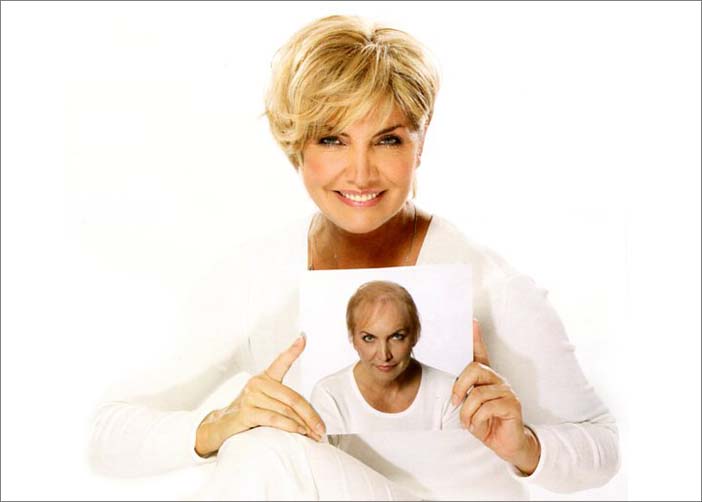 Have you had chemotherapy or radiation? Are you losing your hair as a result of these treatments? Have you noticed that your hair is thinning and that you have bald spots? Do you feel fear or loss?
I recently met a lady who was undergoing chemo and she had a turban on her head. She was obviously self-conscious about how she looked and didn’t look me in the eye when we were speaking. I felt badly for her not only because she was obviously going through a very difficult time in her life, but because she was afraid of what I thought of how she looked. Although I noticed her lovely face and soft speaking voice I couldn’t help but notice her fear.
She told me that she knew that hair loss was inevitable due to her condition and the various treatments necessary for her to overcome her disease but she never really thought about how she would look. When she first began to notice her hair falling out in chunks she began to panic and for weeks she refused to leave her home. She went to doctor’s offices and immediately returned home. She lowered her head when walking to and from the medical building and avoided eye contact with everyone but the medical personnel working with her. She was embarrassed to be seen without the turban covering her bald head even front of her own family members and it began to take it’s toll on her self-esteem. She was becoming a recluse and depression began to set in.
She was afraid of strangers and chastised herself for being vain. Even though she beat herself up for feeling this way the fear grew until she spent most of her time crying and having no life at all. I was overwhelmed by her sadness and wanted to help her.
I decided to let her know about some of the many methods of hair restoration; some temporary and some permanent. I didn’t presume to tell her that she had absolutely nothing to be afraid of…cancer is not something easily overcome, I know…but; she could rid herself of her fear of what strangers thought of her appearance. I told her that she could get a free evaluation in order to explore her options. I’m happy to report that she is now wearing a beautiful wig from Continental Hair and she is as beautiful as she was prior to starting her chemotherapy.
1. the devising or choosing of names for things, especially in a science or other discipline.
Terminology or “buzz words” are common to all professions and if one is an outsider listening in on a conversation between professionals of any given field you will find that you are often a stranger in a strange land! No matter what the profession, there are certain terms that are essential in maintaining a coherent conversation.
The following are some of the terms that are frequently used in the Hair Loss/Restoration industry.
LLLT – Low Level Light/Laser Therapy
LT – Laser Therapy
Hair Piece – A term used for both men and women (but mostly for women)
Toupee – Something a man wears to cover baldness but not used in the Hair Restoration/Replacement Industry because it has an old school and rather
negative connotation.
Wig – Self explanatory
Medical Wig/Medical Prothesis – Designed specifically for someone with a sensitive scalp to due to chemotherapy, radiation therapy of a certain form of Alopecia
Alopecia – Partial or complete absence of hair from areas of the body where it usually grows.
Alopecia Areata – A condition that causes round patches of hair loss can lead to total hair loss.
Alopecia Totalis – Loss of all head hair usually connected to auto-immune disorders and/or stress related disorders.
Alopecia Universealis – Rapid loss of all hair including eyebrows and eye lashes. It is the most severe form of Alopecia Areata.
Traction Alopecia – Gradual hair loss
Trichotillomania – Hair loss caused by pulling ones hair or eyebrows out.
Follicular Unit – Sebaceous oil glands, nerves, small muscles and occasional fine vellus hairs. Usually 1-4 hairs in a follicular unit.
FUT (Follicular Unit Extractions) – Traditional form of transplant using a linear incision made below the occipital bone at the rear of the head.
FUE (Follicular Unit Extraction) – Less invasive way of performing a hair transplant. Done manually, semi-automatically using a mechanical handheld device or robotic device called ARTAS. Rather than a linear incision this removes one follicular unit at a time to be transplanted elsewhere.
DHT (Dihydrotestosterone) – Considered the main cause for male pattern baldness and blocks blood flow to hair follicles. Common treatments are Laser Hair Therapy, Platelet Rich Plasma (PRP) therapy, special shampoos and other wet products help stimulate blood flow to the follicle helping hair to grow again if there is a living follicle present.
So, now you too can understand the language (nomenclature) of the Hair Restoration profession….just make sure that you use the above language in the right context!